
In the institutional precious metals trade, the difference between a mediocre procurement strategy and a sophisticated one is not measured in the margins you negotiate on paper-it is measured in the margins you actually keep after every layer of friction, inefficiency, and hidden cost has extracted its toll.
For decades, institutional buyers have operated under a fundamental misconception: that gold suppliers exist on a linear spectrum from “cheap” to “expensive.” This binary thinking has cost sophisticated capital billions in lost upside. The truth is far more nuanced. The real cost of gold is not its spot price plus a markup. The real cost of gold is the structural friction embedded in your supply chain.
When you source through conventional refineries, brokers, and trading houses, you are not simply paying a premium. You are underwriting the inefficiencies of an entire ecosystem of intermediaries, each extracting margin, each imposing logistical delays, each introducing counterparty risk. Direct mine gold suppliers exist at the opposite end of this spectrum. They compress the supply chain to its minimum, eliminating the parasitic layers that inflate acquisition costs without adding value.
This is not a marginal optimization. For institutional capital, procurement officers, and large-scale manufacturers sourcing precious metals at volume, the difference between buying from a direct mine supplier and buying through conventional channels can represent 8-12% of your total acquisition cost. For a $50 million gold deployment, that difference is $4-6 million in recoverable margin.
This article explains why direct mine gold suppliers matter, how to identify legitimate ones, and how to structure relationships with them in a way that protects your capital while maximizing your structural advantage.
The Economics of Supply Chain Compression
To understand why direct mine gold suppliers offer superior economics, you must first understand how value leaks in a conventional supply chain.
In the traditional precious metals market, raw gold moves through a predictable sequence:
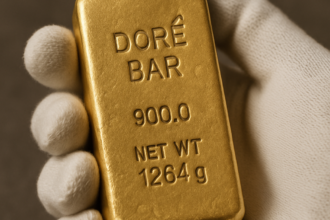
- Artisanal or industrial mine operators extract ore from the ground, process it into rough bullion or dore.
- Local aggregator in the country of origin purchases the material, consolidates small lots into sellable quantities, and manages initial export paperwork.
- Regional trader or export house buys the aggregator’s inventory, secures sovereign export permits, and arranges logistics to an international hub.
- International refinery receives the material, assays it, refines it to 99.99% purity (if required), and certifies it to London Good Delivery standards.
- A bullion bank or trading house purchases the refined material and sells it to the end buyer.
At each step, an intermediary extracts a profit margin, typically 1-3% per layer. For gold, that is not abstract. If the LBMA spot price is $65,000 per kilogram, and you pass through five intermediaries each taking 2%, your acquisition cost increases by 10%, or $6,500 per kilogram.
But the margin extraction is only half the friction cost. The other half is time and liquidity drag.
Each handoff introduces a 3-5 day settlement window. Each intermediary maintains working capital buffers, which they fund at a cost. Each regulatory jurisdiction through which the gold passes introduces customs, royalty, and tax friction. Each logistics partner (shipping, insurance, vaulting) takes a fee. These costs are not always visible in the quote, but they are present in the time-value of money, in the opportunity cost of capital tied up during transit, and in the carrying costs of vault storage at each stage.
When you source directly from a mine supplier, you eliminate virtually all of these layers at once. You are purchasing gold at the point of origin, after it has been extracted and initially processed, but before it has traversed five supply chains, been assayed five times, been vaulted five times, and been re-mortgaged to five different financial institutions.
A direct mine supplier operates a vertically integrated operation: they own or control the extraction, the aggregation, the initial refinement (dore production), the compliance infrastructure (ICGLR certification, export licensing), and the logistics network to move material to a secure international hub or directly to your vault.
Because they control the entire chain, they can offer a realistic, structural discount-typically 4-8% below LBMA spot, depending on volume and specifications-that remains profitable for them because they have eliminated the parasitic middlemen. You save money not because they are desperation-pricing, but because they have redesigned the supply chain to remove waste.
Identifying Legitimate Direct Mine Gold Suppliers
Not all entities claiming to be “direct mine suppliers” actually are. The term has been corrupted by brokers, traders, and phantom operators who use it as marketing cover for the same old intermediary model, or worse, for outright fraud.
A genuine direct mine gold supplier has these characteristics:
Sovereign Licensing in a Production Country: The supplier must be licensed as a mineral dealer, aggregator, or exporter in a jurisdiction that actually produces gold at an industrial scale. The primary hubs are in East Africa (Uganda, Tanzania, Rwanda), West Africa (Ghana, Mali, Burkina Faso), and parts of Southern Africa (Zambia). Do not trust a supplier claiming to be “direct mine” if they are licensed in London, Dubai, or the Bahamas. These are trading hubs, not production hubs. A legitimate supplier owns or controls operations in a geography where the gold is actually extracted.
Verifiable Supply Relationships: A direct mine supplier can articulate the origin of their gold with specificity. They can tell you which mines, which aggregators, which dore producers they source from. They maintain multi-year relationships with these operations because the overhead of managing supply continuity is enormous. A supplier who claims to source “world-class gold” from “multiple undisclosed sources” is either protecting a secret (unlikely) or hiding a lie (common).
On-Ground Physical Infrastructure: Direct mine suppliers operate refineries, dore production facilities, vaulting operations, and assay laboratories in the production country. This is not incidental; it is fundamental. Because they control the processing infrastructure, they can guarantee homogeneity, traceability, and rapid throughput. A supplier who sources material from a production country but processes it elsewhere is not a direct supplier; they are a trader using geography as marketing.
Institutional Compliance Architecture. Legitimate direct mine suppliers invest heavily in compliance because their business model depends on it. They maintain ICGLR certification, OECD due diligence compliance, AML/KYC procedures, ESG frameworks, and regular third-party audits. These are not optional nice-to-haves; they are the price of entry to the institutional market. A supplier offering to “work around” compliance or offering material that is “not quite certified yet” is signaling that they cannot clear legitimate channels.
Institutional Banking Relationships. Direct mine suppliers maintain Tier-1 banking relationships (SWIFT, LC capabilities, correspondent networks) because this is how they settle transactions with institutional buyers. They maintain credit lines with these banks, which means the banks have underwritten their operations. A supplier who insists on payment via cryptocurrency, wire to an obscure jurisdiction, or through “special corridors” is not a direct supplier; they are a financial engineer managing fraud risk.
The Geographic Advantage: East African Supply Hubs
The most sophisticated direct mine gold suppliers operate in East Africa, particularly Uganda, Rwanda, and Tanzania. This is not accidental; it is a product of geology, infrastructure, and regulatory evolution.
The Great Lakes region is adjacent to some of the world’s highest-yielding gold deposits, particularly in the DRC. This geographic proximity means that gold sourced from DRC mines can reach processing and export facilities in Kampala or Kigali within days, not weeks. The gold incurs minimal logistics costs and minimal cross-border friction.
But geography alone is not sufficient. What makes East Africa exceptional is the modernization of its trade infrastructure over the past 15 years.
Uganda, in particular, has built a sophisticated ecosystem around the precious metals trade. It hosts state-of-the-art dore production facilities, independent assay laboratories accredited to international standards, secure vault operations, and a growing network of licensed mineral dealers. The country has implemented the ICGLR compliance framework, which allows gold sourced from the Great Lakes region to be certified as conflict-free and OECD-compliant, a prerequisite for sale to Western refineries and institutional buyers.
More importantly, Uganda’s regulatory environment has professionalized. The government requires mineral dealers to maintain minimum capital requirements, undergo regular inspections, and submit to an audit. This creates a self-filtering effect: only serious operators with legitimate supply chains can maintain licensing. Phantom operators and smugglers cannot survive regulatory scrutiny.
A direct mine supplier based in Kampala can source gold from DRC mines, process it into homogeneous dore bars, assay it to verified purity, secure export documentation from the Ministry of Energy and Mineral Development, and deliver it to your vault or refinery within 10-14 days. The entire transaction is documented, compliant, and reversible.
Evaluating the Rate: What Is Legitimately Discounted, What Is Hidden Cost
When a direct supplier quotes you a rate, your instinct will be to compare it narrowly to the LBMA spot price and look for the largest discount percentage.
This is a mistake.
A sophisticated evaluation requires understanding what services and costs are embedded. A lower upfront discount that leaves you holding regulatory, logistical, or assay risk is often more expensive than a slightly higher rate offering a complete, turnkey solution.
When evaluating a rate, decompose it into these components:
Sovereign Export Clearance – The supplier’s rate must account for the cost of securing a government export permit in the country of origin. This involves paying state royalties (typically 3-5% of value), securing tax clearance, and obtaining ministerial approval. A supplier quoting a rate that does not cover these costs is implicitly asking you to handle them, which means traveling to the country, hiring a local facilitator, and exposing yourself to bureaucratic risk. Legitimate suppliers build these costs into their margin.
ICGLR and ESG Certification – Gold that cannot be verified as conflict-free is unsellable to major Western refineries. The cost of ICGLR certification, OECD due diligence documentation, and independent assay verification must be covered. A supplier offering material at a cut-rate price because it is “not yet certified” is offering you a liability, not an asset.
Refining and Homogenization – If the supplier is delivering dore (semi-refined gold), the rate should reflect the cost of processing artisanal or alluvial gold into consistent, homogeneous material. This is a real cost; it involves smelting, loss estimation, labor, and energy. A supplier quoting the same rate for inconsistent raw material as for refined dore bars is misquoting.
Logistics and Insurance – The rate should specify whether delivery is FOB (Free On Board-you pay shipping and insurance) or CIF (Cost, Insurance, and Freight-the supplier covers it). CIF is more expensive upfront, but it eliminates your logistics risk and simplifies settlement. For institutional buyers, CIF is typically preferable because it ensures the asset is insured and trackable end-to-end.
Physical Verification and Assay – A legitimate rate includes the cost of independent fire assaying in your presence, performed by a government-accredited laboratory. This protects you from metallurgical misrepresentation and is non-negotiable for institutional transactions. A supplier unwilling to assay in front of you is unwilling to stand behind the gold.
The Execution Protocol: How to Structure a Transaction with a Direct Mine Supplier
Once you have identified a legitimate direct mine gold supplier and negotiated a realistic rate, the mechanics of execution are critical. This is where the difference between institutional-grade sourcing and amateur hour becomes immediately apparent.
Step 1: The Formal Corporate Offer. Do not rely on emails or WhatsApp messages for pricing. Insist on the supplier issuing a Full Corporate Offer (FCO). This legally binding document must explicitly state the origin of the gold, the exact discount to the LBMA spot price, the currency of settlement, and the Incoterms governing the handover of the asset.
Step 2: License Verification. Before accepting any rate, verify that the supplier has the legal authority to fulfill the contract. Request their Mineral Dealer’s License and cross-reference it directly with the issuing government ministry. Only licensed entities can provide a risk-adjusted rate. Unlicensed entities can only provide risk.
Step 3: The Table Top Meeting (TTM). The most competitive rate in the world is meaningless if the gold does not exist. Top-tier suppliers require the buyer or their proxy to travel to the origin hub (e.g., Kampala). This allows physical inspection of the metal. The gold is moved to a secure refinery, smelted into homogeneous dore bars, and assayed in the buyer’s presence.
Step 4: Independent Assay. The gold is submitted for fire assay at a government-accredited independent laboratory. You attend the assay or have a proxy present. The assay report specifies the exact pure gold content, down to the decimal point. Your rate is locked based on this verified figure, not on the supplier’s estimate. Metallurgical risk is eliminated.
Step 5: Export Documentation and Payment. Once the assay confirms purity and the government has issued the export permit, you transfer payment via corporate SWIFT transfer. This happens only after the fire assay confirms the purity and the government has issued the export documentation. With these processes in place, you know that your capital is deployed against a verified, legally exportable asset, locking in your negotiated margin with absolute certainty.
The entire process, from FCO to final delivery, typically takes 10-21 days. It is not instantaneous, but it is far faster than conventional channels, and the documentation is ironclad.
Why Direct Mine Gold Suppliers Outcompete Traditional Channels
Direct mine gold suppliers compete on three dimensions that traditional intermediaries cannot match:
Speed: A conventional supply chain takes 4-6 weeks. A direct relationship takes 10-21 days. For capital that is time-sensitive or deployed in tranches, this is a material advantage.
Transparency: A conventional chain obscures the gold’s origins, its processing costs, and its regulatory status. A direct supplier provides end-to-end documentation. You know exactly what you are buying and where it came from.
Margin Retention: A conventional chain extracts 8-12% in cumulative intermediate margin. Direct sourcing retains that margin for you. For $100 million in gold sourcing, this is $8-12 million in recoverable profit.
The math is compelling. This is why institutional capital, corporate treasury departments, and large-scale manufacturers increasingly insist on direct supplier relationships.
Conclusion: Strategic Supply Chain Optimization for Institutional Capital
In precious metals procurement, as in all capital deployment, competitive advantage flows to those who understand structural economics, not tactical pricing. Direct mine gold suppliers represent a structural advantage: they compress supply chains, eliminate parasitic intermediaries, and pass the resulting efficiency gains directly to sophisticated buyers.
This is not a marginal play or a speculative arbitrage. It is the intelligent restructuring of a mature, global commodity supply chain. For institutional capital, the choice is stark: continue sourcing through conventional channels and cede 8-12% of margin to an ecosystem of intermediaries, or partner with a direct mine supplier and retain that margin for yourself.
The suppliers who can deliver this advantage are few, and they distinguish themselves through verifiable licensing, transparent sourcing, institutional compliance infrastructure, and a willingness to submit to rigorous physical verification.
If you are sourcing precious metals at an institutional scale, the question is no longer whether to consider direct mine suppliers. The question is which direct supplier can be trusted to deliver the speed, transparency, and margin advantage your capital deployment requires.
Noble Ore Mining provides institutional capital, private wealth funds, and large-scale manufacturers with direct access to realistically priced, fully documented gold from the Great Lakes region. Our vertically integrated infrastructure, from mine aggregation through sovereign export, eliminates the friction costs embedded in conventional supply chains. To explore how direct mine sourcing can structurally optimize your precious metals strategy, contact our institutional partnerships team today.