

Legal gold exporters operate under strict regulatory frameworks to ensure legitimate precious metals trading across international borders. This guide is designed for miners, precious metals dealers, importers, and investors who need to identify and work with properly licensed gold trading companies.
Gold export licensing requirements vary significantly by country, with each jurisdiction maintaining specific categories of authorized operations. Licensed precious metals exporters must obtain proper documentation before conducting any cross-border transactions, and understanding these regulations protects you from costly legal issues.
We’ll explore the different categories of legal gold trading operations and how licensing systems work in practice. You’ll also discover how to verify legitimate gold export businesses through official registries and regulatory databases. Finally, we’ll examine current gold export market trends and provide practical steps for connecting with verified gold exporters by region.
Working with authorized gold dealers gives you access to transparent pricing, regulatory compliance, and secure transaction processes that protect both buyers and sellers in the global precious metals market.
Understanding Gold Export Licensing Requirements
Central Bank Regulations and Compliance Standards
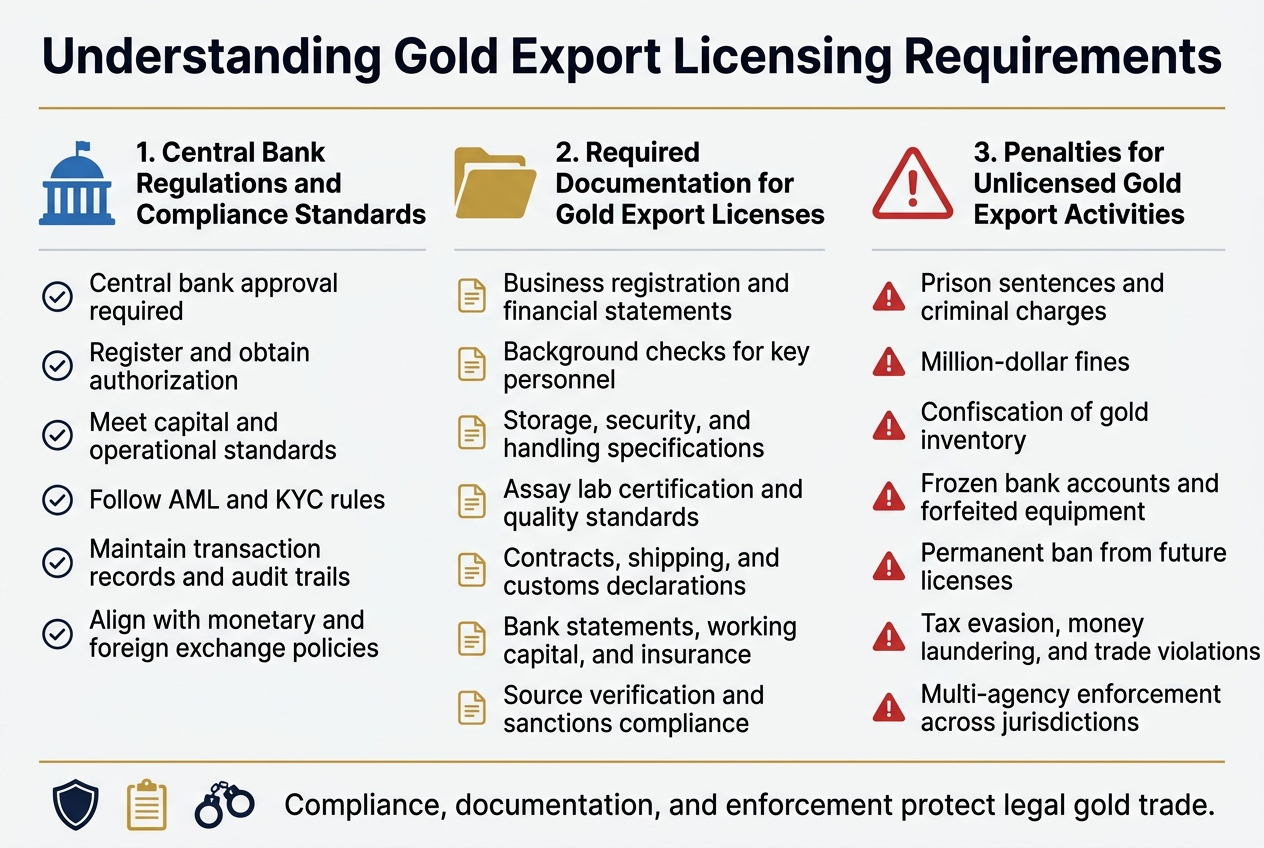
Legal gold exporters must navigate a complex web of central bank regulations and compliance standards that vary significantly across jurisdictions. Central banks serve as the primary regulatory bodies overseeing gold export activities, establishing comprehensive frameworks to ensure transparency and prevent illicit trading practices.
The regulatory landscape requires exporters to demonstrate full compliance with monetary policies and foreign exchange regulations. Central banks typically mandate that all gold export operations align with national economic policies and international trade agreements. These institutions monitor gold flows to maintain currency stability and ensure that precious metal exports don’t compromise national reserves or economic security.
Licensed gold trading companies must register with their respective central banks and obtain proper authorization before engaging in international gold transactions. This registration process involves rigorous background checks, financial audits, and verification of business legitimacy. Central banks also establish minimum capital requirements and operational standards that exporters must maintain throughout their licensing period.
Compliance standards encompass anti-money laundering (AML) protocols, know-your-customer (KYC) requirements, and detailed transaction reporting systems. Exporters must implement robust record-keeping systems that track the origin, ownership, and destination of all gold shipments. Regular audits and compliance reviews ensure that licensed exporters maintain adherence to these stringent standards.
Required Documentation for Gold Export Licenses
The documentation requirements for gold export licensing are extensive and carefully regulated to ensure complete transparency in international gold trade. Legal gold exporters must prepare comprehensive documentation packages that demonstrate their legitimacy and operational capacity.
Essential documentation includes proof of business registration, detailed financial statements, and evidence of adequate insurance coverage for gold handling and transportation. Exporters must also provide comprehensive background information about key personnel, including directors, managers, and authorized signatories involved in gold trading operations.
Technical documentation requirements include detailed specifications of storage facilities, security protocols, and handling procedures. Exporters must demonstrate compliance with international gold quality standards and provide certification from recognized assay laboratories. Documentation must also include detailed export transaction records, including contracts with foreign buyers, shipping arrangements, and customs declarations.
Financial documentation encompasses bank statements, proof of adequate working capital, and evidence of established banking relationships with recognized financial institutions. Many jurisdictions require exporters to maintain specific insurance policies covering theft, loss, and liability associated with gold handling and international transportation.
Additional documentation may include environmental compliance certificates, mining source verification for domestically sourced gold, and proof of compliance with international trade sanctions and embargo requirements.
Penalties for Unlicensed Gold Export Activities
The penalties for engaging in unlicensed gold export activities are severe and can include both criminal and civil sanctions. Regulatory authorities impose stringent enforcement measures to maintain the integrity of legal gold export markets and prevent illicit trading activities.
Criminal penalties for unlicensed gold export can include substantial prison sentences, often ranging from several years to decades depending on the scale and nature of the violations. Financial penalties typically involve substantial fines that can reach millions of dollars, calculated based on the value of illegally exported gold and the duration of unlicensed activities.
Civil penalties include immediate confiscation of all gold inventory involved in illegal export activities, freezing of associated bank accounts, and forfeiture of equipment used in unlicensed operations. Violators may also face permanent bans from obtaining legitimate export licenses in the future, effectively excluding them from legal participation in the gold export industry.
Beyond direct penalties, unlicensed gold export activities can result in additional legal consequences including prosecution for tax evasion, money laundering charges, and violations of international trade regulations. These compound penalties can significantly amplify the total legal and financial exposure for individuals and organizations engaged in unlicensed activities.
The enforcement of these penalties involves collaboration between multiple agencies, including customs authorities, financial intelligence units, and international law enforcement organizations, ensuring that violators face comprehensive legal consequences across multiple jurisdictions.
Categories of Legal Gold Trading Operations
Domestic Gold Trading Without License Requirements
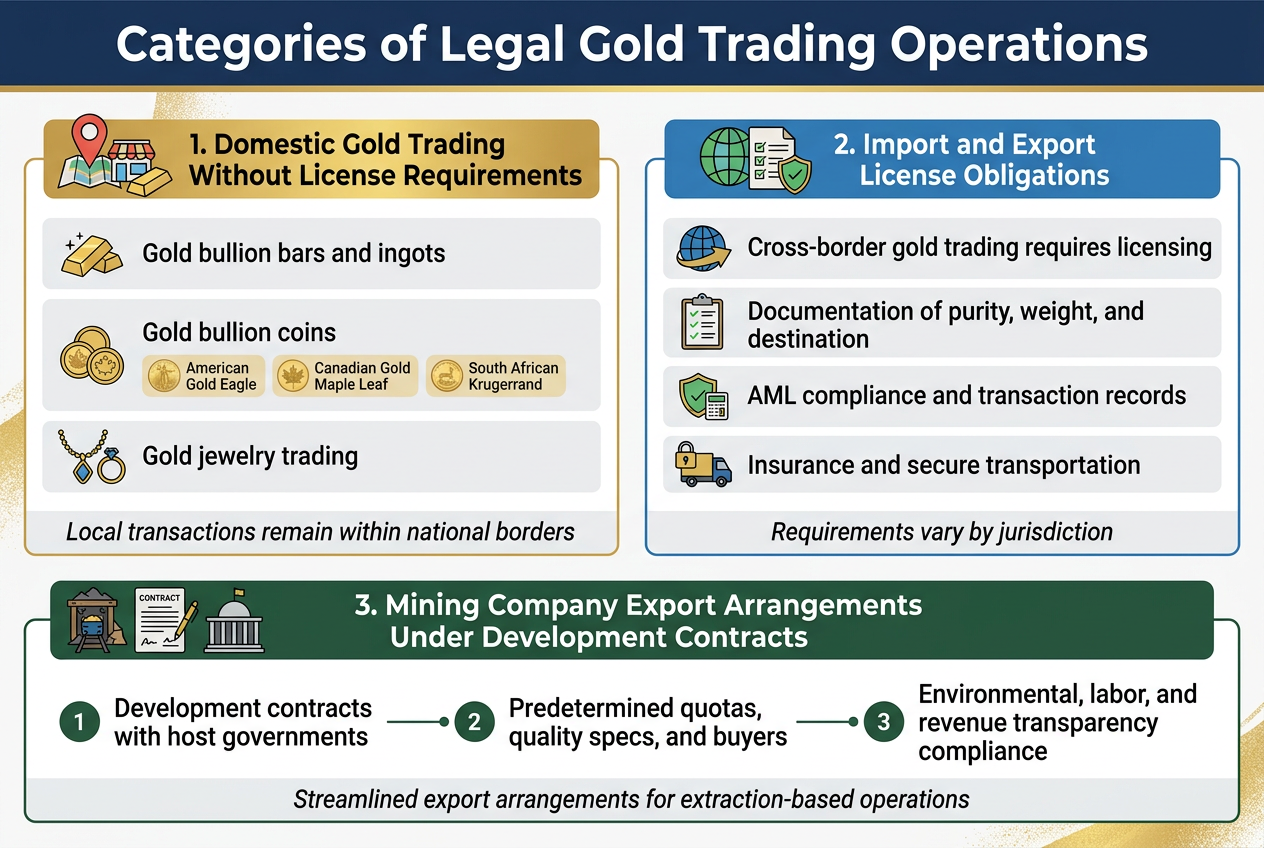
Understanding the distinction between domestic and international gold trading operations is crucial for legitimate businesses. Within domestic markets, certain gold trading activities may not require specific export licenses, as they involve transactions that remain within national borders. These operations typically include local gold dealers who purchase and sell gold bullion, coins, and jewelry to domestic customers without crossing international boundaries.
Domestic gold trading encompasses various forms of precious metals transactions, including gold bullion bars and ingots that are traded based on weight and purity standards. Popular gold bullion coins such as the American Gold Eagle, Canadian Gold Maple Leaf, and South African Krugerrand represent significant portions of domestic trading volumes. These standardized products facilitate easier valuation and transfer within national markets.
Gold jewelry trading also constitutes a substantial segment of domestic operations, particularly in regions with high cultural demand for ornamental gold. Retail gold jewelry transactions, typically involving 14-karat to 24-karat gold pieces, remain within domestic jurisdiction and generally do not trigger international export licensing requirements.
Import and Export License Obligations
Now that we have covered domestic operations, it’s essential to understand that international gold trading requires comprehensive licensing compliance. Licensed gold trading companies must navigate complex regulatory frameworks when conducting cross-border transactions. Gold export licensing requirements vary significantly between jurisdictions, but most countries mandate specific permits for precious metals exports.
Import and export license obligations typically involve detailed documentation of gold purity, weight, and intended destination. Authorized gold dealers must maintain meticulous records of all international transactions, ensuring compliance with both origin and destination country regulations. These requirements extend beyond simple documentation to include verification of legitimate business purposes and anti-money laundering compliance.
The licensing process often requires businesses to demonstrate financial stability, proper storage facilities, and established relationships with verified gold exporters by region. International gold export regulations frequently mandate insurance coverage and secure transportation arrangements to protect against theft or loss during transit.
Mining Company Export Arrangements Under Development Contracts
With this regulatory framework in mind, mining companies operate under specialized export arrangements that differ from traditional trading licenses. These legitimate gold export businesses typically establish development contracts with host governments that outline specific export terms and revenue-sharing agreements.
Mining operations benefit from streamlined licensing processes due to their direct extraction activities and established government relationships. Their export arrangements often include predetermined quotas, quality specifications, and designated international buyers. These contracts provide legal framework for continuous export operations while ensuring compliance with local mining laws and international trade regulations.
Development contracts frequently incorporate provisions for gold trading license verification and ongoing regulatory compliance monitoring. Mining companies must demonstrate adherence to environmental standards, labor regulations, and revenue transparency requirements as part of their export authorization process.
Verified Licensed Gold Exporters by Region
Papua New Guinea Licensed Alluvial Gold Exporters
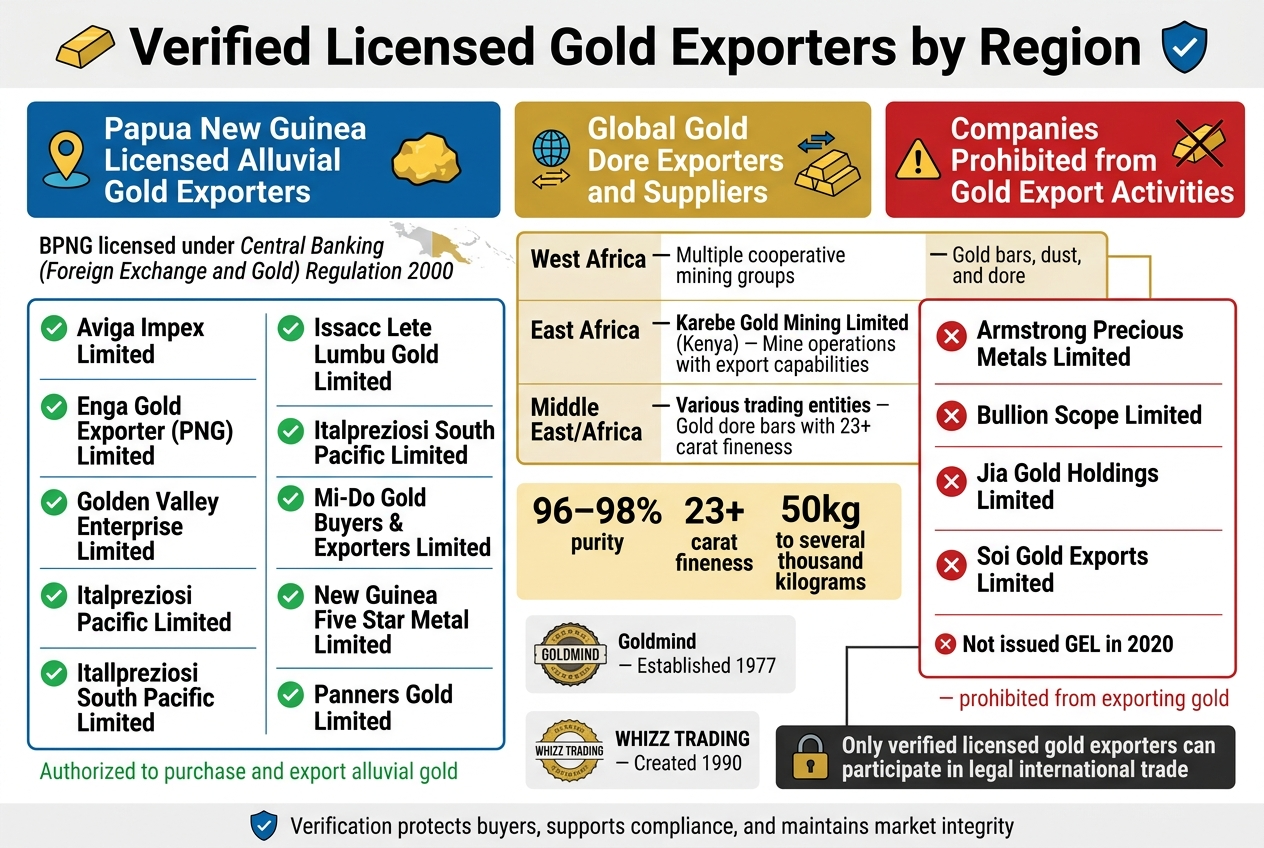
The Bank of Papua New Guinea (BPNG) maintains strict oversight of legal gold exporters through its licensing system under the Central Banking (Foreign Exchange and Gold) Regulation 2000. For 2020, BPNG officially licensed eight companies as authorized alluvial gold exporters, creating a verified network of legitimate gold export businesses.
The following licensed gold trading companies have been granted official Gold Export Licenses (GEL) by BPNG:
- Aviga Impex Limited
- Enga Gold Exporter (PNG) Limited
- Golden Valley Enterprise Limited
- Issacc Lete Lumbu Gold Buyers Limited
- Italpreziosi South Pacific Limited
- Mi-Do Gold Buyers & Exporters Limited
- New Guinea Five Star Metal Limited
- Panners Gold Limited
These verified gold exporters by region represent the complete list of legal entities authorized to purchase and export alluvial gold from Papua New Guinea. Anyone seeking to sell alluvial gold can conduct business safely with any of these licensed precious metals exporters, ensuring compliance with international gold export regulations.
Global Gold Dore Exporters and Suppliers
Beyond Papua New Guinea’s regulated market, the global gold dore export industry features numerous suppliers operating across different regions. Based on available market data, several companies have established themselves as active participants in the international gold dore trade.
Key global suppliers include operations spanning multiple continents:
| Region | Notable Operations | Specialization |
|---|---|---|
| West Africa | Multiple cooperative mining groups | Gold bars, dust, and dore |
| East Africa | Karebe Gold Mining Limited (Kenya) | Mine operations with export capabilities |
| Middle East/Africa | Various trading entities | Gold dore bars with 23+ carat fineness |
Companies like Goldmind, established in 1977, and WHIZZ TRADING, created in 1990, represent established players in the international precious metals trade. These authorized gold dealers typically offer gold dore bars with purity levels ranging from 96-98% and fineness of 23+ carats, with quantities varying from 50kg to several thousand kilograms.
The market shows active participation from mining cooperatives, particularly in Côte d’Ivoire and West Africa, where organizations represent multiple local mining groups and maintain substantial inventory levels for international distribution.
Companies Prohibited from Gold Export Activities
Gold export market trends reveal the critical importance of license verification, as regulatory authorities maintain active lists of prohibited entities. In Papua New Guinea’s case, BPNG specifically identified companies that were denied Gold Export Licenses in 2020, making their export activities illegal under current regulations.
The following companies were not issued GEL in 2020 by BPNG and are therefore prohibited from exporting gold:
- Armstrong Precious Metals Limited
- Bullion Scope Limited
- Jia Gold Holdings Limited
- Soi Gold Exports Limited
These entities represent clear examples of how gold trading license verification systems work to protect the legitimate gold export market. Any transactions with these unlicensed operators would violate Papua New Guinea’s Central Banking regulations and could result in legal consequences for all parties involved.
The regulatory framework emphasizes that anyone caught exporting gold without a valid GEL will face enforcement action under the Central Banking (Foreign Exchange and Gold) Regulation 2000. This enforcement mechanism ensures that only verified licensed gold exporters can participate in legal international trade, protecting buyers and maintaining market integrity across the region’s gold export activities.
Benefits of Working with Licensed Gold Exporters
Regulatory Compliance and Legal Protection
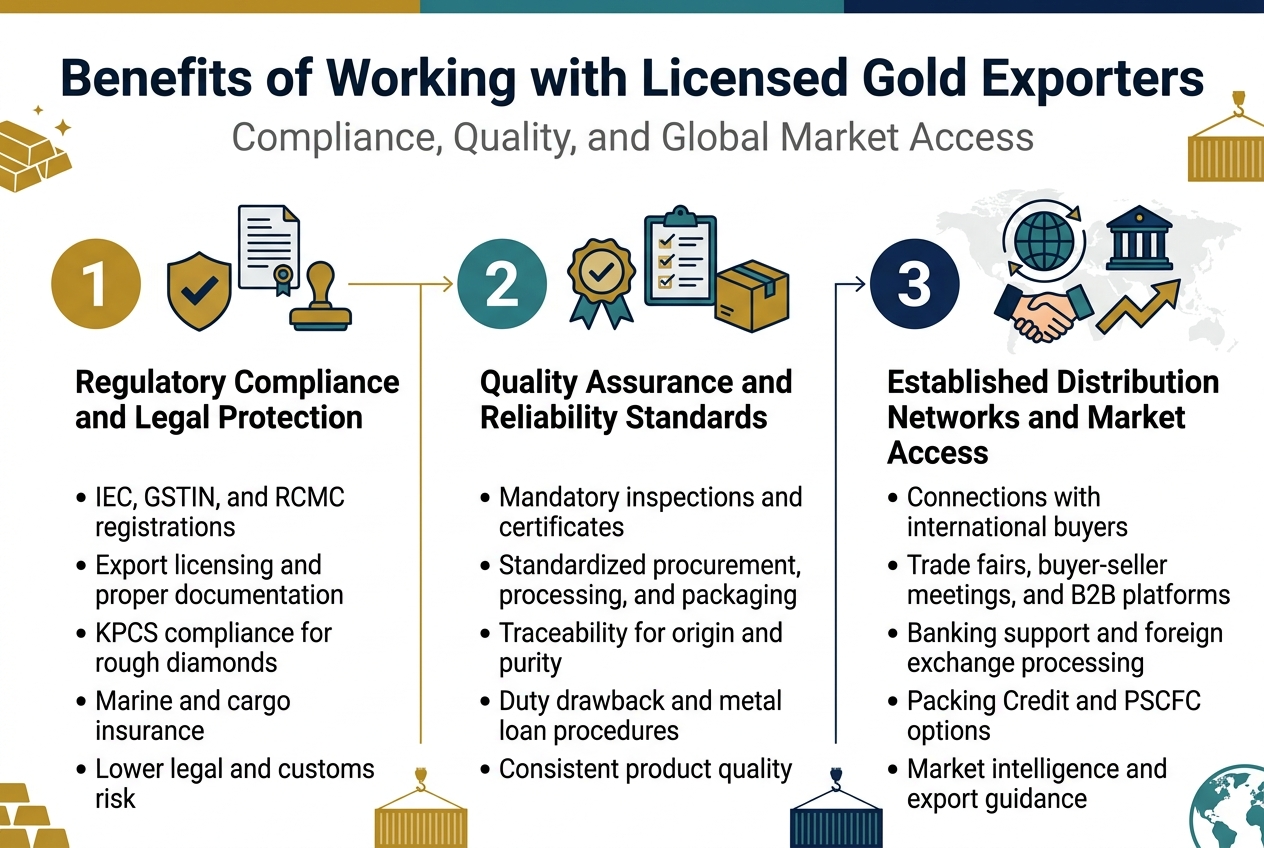
Working with licensed gold exporters provides essential regulatory compliance that protects businesses throughout the export process. Licensed exporters possess all necessary registrations and certifications required by international trade regulations, including Importer-Exporter Codes (IEC), Goods and Services Tax Identification Numbers (GSTIN), and Registration cum Membership Certificates (RCMC) from relevant Export Promotion Councils like the Gem and Jewellery Export Promotion Council (GJEPC).
These legal gold exporters maintain compliance with export licensing requirements and follow proper procedures for documentation, including shipping bills, bills of lading, certificates of origin, and inspection certificates. For specialized products like rough diamonds, licensed exporters ensure adherence to the Kimberley Process Certification Scheme (KPCS), which is mandatory for exports under specific HS codes. This regulatory framework provides legal protection against potential violations and ensures all transactions meet international trade standards.
Licensed exporters also maintain proper insurance coverage for marine and cargo protection, reducing risks associated with international shipments. Their compliance with Foreign Trade Policy regulations and customs procedures eliminates potential legal complications that could arise from working with unlicensed operators.
Quality Assurance and Reliability Standards
Licensed gold trading companies implement comprehensive quality control measures that ensure product integrity throughout the export process. These authorized gold dealers arrange for mandatory inspections by concerned agencies and obtain certificates of inspection, which are essential requirements for customs clearance and banking documentation.
Professional licensed exporters follow standardized procedures for procurement, processing, and packaging of gold products. They maintain detailed documentation systems that track product origin, quality specifications, and processing history. This systematic approach ensures consistency in product quality and provides buyers with confidence in the authenticity and purity of exported materials.
The reliability standards maintained by licensed exporters include proper handling of duty drawback schemes, metal loan facilities, and replenishment schemes. These structured approaches to gold procurement and export demonstrate the professional standards that licensed operators maintain compared to unlicensed alternatives.
Established Distribution Networks and Market Access
Licensed precious metals exporters have developed extensive distribution networks and established relationships with international buyers, providing access to global markets that may be difficult for individual businesses to penetrate. These networks include connections with overseas importers, participation in international trade fairs, buyer-seller meetings, and established presence on B2B platforms.
Licensed exporters maintain relationships with authorized banks dealing in foreign exchange, enabling smooth payment processing and export credit facilities. They provide access to pre-shipment and post-shipment credit options, including Packing Credit and Post-Shipment Credit in Foreign Currency (PSCFC), which facilitate working capital management for export operations.
These established networks also provide market intelligence and insights into international gold export market trends, helping businesses make informed decisions about timing, pricing, and target markets. Licensed exporters often have preferential access to export benefits available under Foreign Trade Policy for specific countries and can guide businesses through the complexities of international trade regulations across different jurisdictions.
How to Identify and Verify Legitimate Gold Exporters
Checking Official Banking Authority Lists
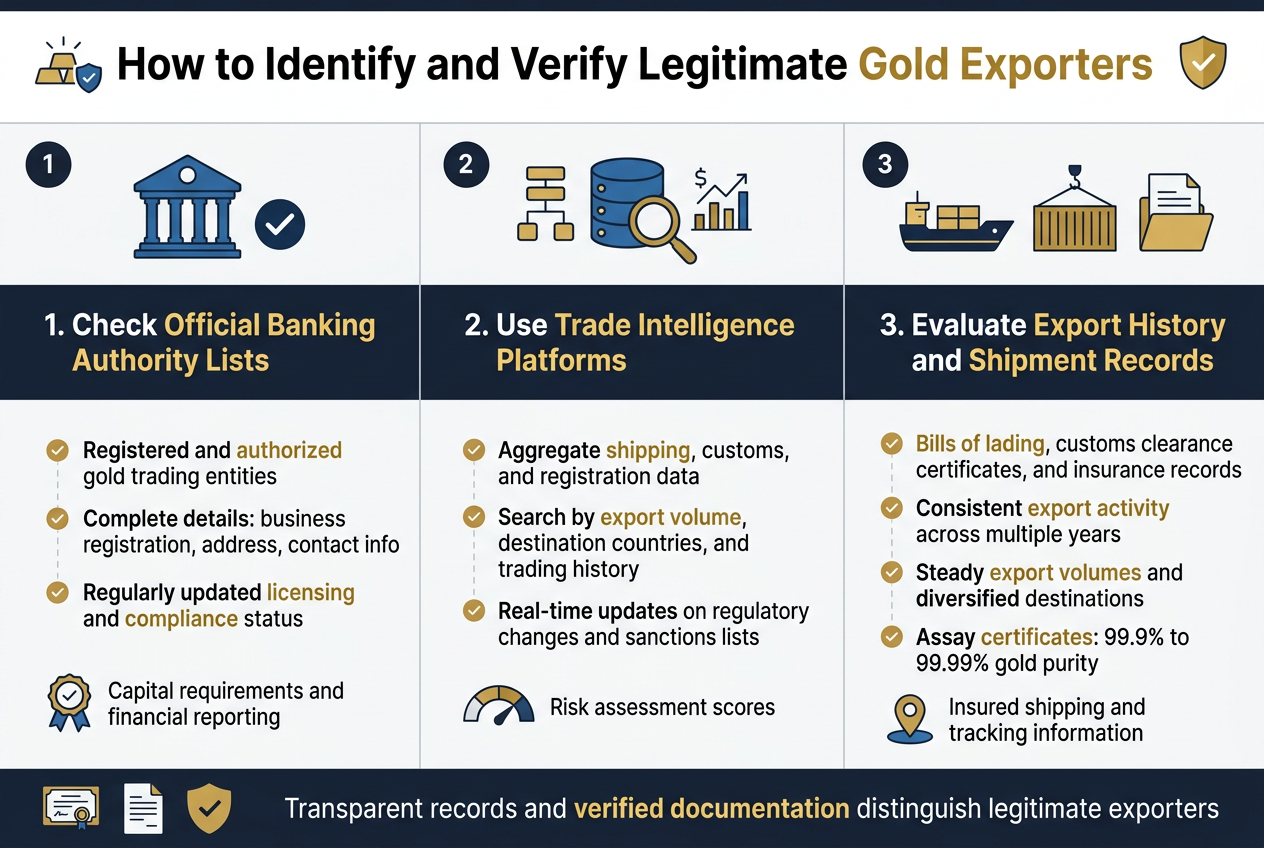
Banking authorities maintain comprehensive databases of registered and authorized gold trading entities within their jurisdictions. These official repositories serve as the primary verification source for legitimate gold export businesses. Central banks and financial regulatory bodies typically publish lists of companies that have obtained proper licensing for precious metals trading and export activities.
When reviewing banking authority lists, focus on companies that display complete registration details, including business registration numbers, physical addresses, and contact information. Verified gold exporters will have their credentials prominently displayed and can provide documentation upon request. These authorities regularly update their databases to reflect current licensing status and any regulatory changes affecting authorized dealers.
Most banking institutions require gold exporters to maintain specific capital requirements and provide regular financial reporting to maintain their authorized status. This ongoing oversight ensures that only financially stable and compliant companies remain on official lists.
Using Trade Intelligence Platforms for Verification
Trade intelligence platforms aggregate data from multiple sources to provide comprehensive verification services for gold export companies. These platforms compile shipping records, customs documentation, and business registration information to create detailed profiles of legitimate gold export businesses.
Professional trade databases allow users to search for companies by various criteria, including export volume, destination countries, and historical trading patterns. Verified gold exporters typically demonstrate consistent trading activity with proper documentation across multiple years. These platforms often include risk assessment scores based on compliance history and financial stability indicators.
Many trade intelligence services provide real-time updates on regulatory changes and sanctions lists, ensuring that potential business partners remain compliant with international trade regulations. This dynamic verification approach helps identify companies that may have lost their authorization or faced regulatory action.
Evaluating Export History and Shipment Records
A thorough examination of export history and shipment records provides crucial insights into the legitimacy and operational capacity of gold exporters. Authentic gold export companies maintain detailed transaction histories that demonstrate consistent business operations and compliance with international shipping requirements.
Legitimate exporters can provide verifiable shipment documentation, including bills of lading, customs clearance certificates, and insurance records for their gold shipments. These records should show regular export activity to multiple destinations, indicating established trade relationships and operational expertise.
Export volume consistency serves as another key indicator of legitimate operations. Verified gold suppliers typically maintain steady export volumes that align with their stated business capacity and market presence. Sudden spikes or inconsistent shipping patterns may indicate questionable business practices.
When evaluating shipment records, examine the destinations and frequency of exports. Established gold exporters usually have diversified customer bases across multiple regions and maintain long-term trading relationships. Documentation should include proper assay certificates confirming gold purity levels, typically ranging from 99.9% to 99.99% for investment-grade products.
Companies with transparent export histories also provide tracking information and maintain insured shipping practices for high-value gold shipments. This level of documentation and operational transparency distinguishes legitimate exporters from potentially fraudulent operators in the gold trading market.
Market Trends and Data Analysis for Gold Exports
Global Demand Patterns and Growth Drivers
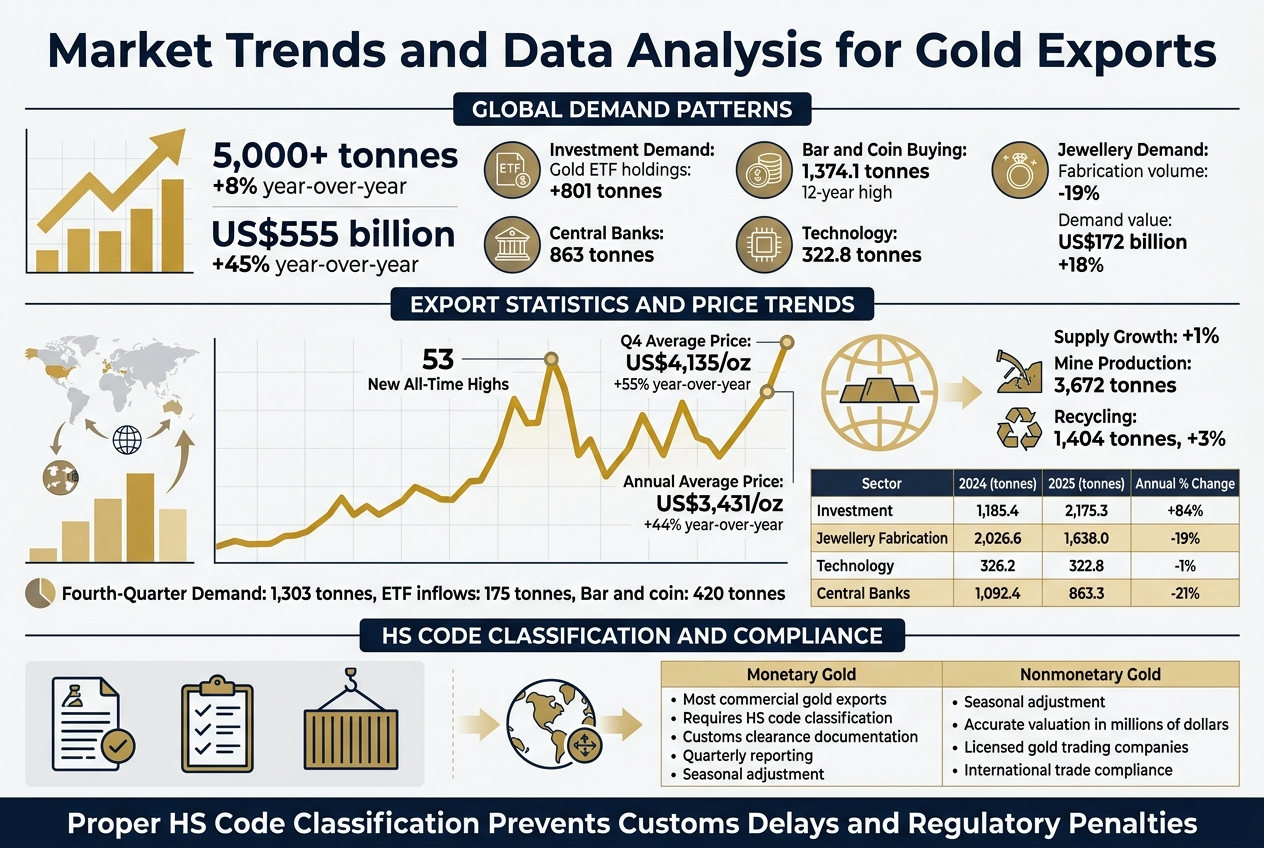
The global gold export market experienced unprecedented growth in 2025, with total demand exceeding 5,000 tonnes for the first time in history, representing a remarkable 8% increase from the previous year. This surge in demand created exceptional opportunities for legal gold exporters worldwide, as the combined value reached an unprecedented US$555 billion, marking a 45% year-over-year increase.
Investment demand emerged as the primary growth driver, with heightened activity across multiple segments. Gold ETF holdings expanded by 801 tonnes, representing the second strongest year on record for licensed gold trading companies serving institutional investors. Bar and coin purchasing accelerated to reach a 12-year high of 1,374.1 tonnes, demonstrating robust retail investor confidence. Safe-haven motives, diversification strategies, and price-driven motivations consistently fueled investment interest throughout the year.
Central bank purchases maintained their historically elevated levels at 863 tonnes, reaching the upper end of projected ranges. These purchases remained geographically widespread, providing stable demand patterns for authorized gold dealers operating in international markets. Technology sector demand remained stable at 322.8 tonnes despite consumer electronics disruptions, supported by continued growth in AI-related applications that require precious metals components.
Now that we have covered the demand fundamentals, jewellery demand volumes declined as expected due to successive record gold price highs, dropping 19% in fabrication volumes. However, sentiment toward gold jewellery remained exceptionally positive, with global demand value climbing 18% to a record US$172 billion, indicating that legal gold exporters serving the luxury market maintained strong revenue streams despite volume contractions.
Export Statistics for Strategic Decision Making
With these market dynamics in mind, export statistics reveal critical patterns for strategic planning. The LBMA gold price established 53 new all-time highs during 2025, with an average Q4 price reaching a record US$4,135 per ounce, representing a 55% year-over-year increase. The annual average price of US$3,431 per ounce marked a 44% increase, fundamentally altering the economic landscape for verified gold exporters by region.
Supply-side metrics showed total annual gold supply growth of 1%, with mine production reaching a new record of 3,672 tonnes. This modest supply increase against surging demand created favorable conditions for licensed precious metals exporters. Recycling activity gained 3% to 1,404 tonnes, representing a relatively muted response to the 67% increase in US dollar gold prices, indicating potential future supply constraints.
| Sector | 2024 (tonnes) | 2025 (tonnes) | Annual % Change |
|---|---|---|---|
| Investment | 1,185.4 | 2,175.3 | +84% |
| Jewellery Fabrication | 2,026.6 | 1,638.0 | -19% |
| Technology | 326.2 | 322.8 | -1% |
| Central Banks | 1,092.4 | 863.3 | -21% |
Fourth-quarter demand reached a record 1,303 tonnes, the highest ever for any fourth quarter, driven by substantial ETF inflows of 175 tonnes and bar and coin purchasing hitting a 12-year high of 420 tonnes. These statistics demonstrate the critical importance for legitimate gold export businesses to maintain adequate inventory levels and supply chain flexibility to capitalize on demand surges.
HS Code Classification for International Trade
Previously, we’ve established the market dynamics, and now we must address the technical requirements for international gold export operations. The Harmonized System (HS) code classification for gold exports falls under specific categories that legal gold exporters must understand for compliance with international trade regulations.
Based on the reference data from U.S. Bureau of Economic Analysis tracking “Exports of Goods: Nonmonetary gold,” exporters must distinguish between monetary and nonmonetary gold classifications. Nonmonetary gold, which includes most commercial gold exports, requires specific documentation and classification codes for customs clearance. The quarterly reporting frequency indicates that authorized gold dealers must maintain detailed transaction records for regulatory compliance.
Licensed gold trading companies operating internationally must ensure proper HS code classification to avoid customs delays and regulatory complications. The seasonal adjustment of export data suggests that gold export licensing requirements account for market volatility and seasonal demand patterns. Proper classification becomes crucial when dealing with the substantial volumes indicated in the market data, where even minor classification errors can result in significant delays or penalties.
The standardized reporting requirements reflected in the millions of dollars valuation methodology demonstrate that verified gold exporters by region must maintain sophisticated tracking systems. These systems must accommodate the dramatic price volatility evidenced by the 44% annual price increase, ensuring accurate valuation declarations that comply with international trade regulations while maximizing operational efficiency for legitimate export operations.
Connecting with Licensed Gold Export Companies

Direct Contact Information for Authorized Exporters
Now that we have covered verification methods, establishing direct contact with licensed gold trading companies requires adherence to strict institutional protocols. Legal gold exporters maintain highly regulated communication channels that differ significantly from typical business interactions.
Imperial Global Gold Ltd., as an example of institutional-grade operations, demonstrates the standard approach among legitimate exporters. They exclusively accept inquiries from verified institutional entities, including licensed bullion dealers, financial institutions, government-approved intermediaries, and authorized legal or consulting firms acting on behalf of verified clients. These companies do not engage in retail or private transactions, informal brokerage activities, or communication through personal email addresses, messaging applications, or social media platforms.
All official correspondence must be conducted through approved corporate communication channels for compliance, security, and record-keeping purposes. Institutional verification is mandatory before any pricing, documentation, or commercial discussions can commence. Incomplete, unverifiable, or non-institutional submissions will not be processed by legitimate gold export operations.
Trade Platform Resources for Supplier Discovery
Previously, I’ve established that regulatory bodies maintain comprehensive databases of authorized gold exporters. The Minerals Commission’s official registry provides a substantial foundation for supplier discovery, listing dozens of verified licensed gold trading companies with their respective license validity periods.
This registry includes established operations such as ROYAL GHANA GOLD LIMITED (licensed until 2030), GOLD COAST REFINERY LIMITED, AUREATE MINERAL REFINERY LTD, and SWISS GOLD VALUE (GHANA) LIMITED. Each listed company operates under specific licensing periods, with renewals required at regular intervals to maintain legal export status.
The registry spans various operational categories, from specialized refineries like Mentrax Refinery Ltd. to comprehensive trading operations such as M & C GOLD AND PRECIOUS METALS REFINERY LIMITED. These platforms serve as the primary resource for identifying legitimate suppliers within specific jurisdictions, ensuring all potential partners maintain current licensing status.
Building Long-term Partnerships with Verified Exporters
With this in mind, successful partnerships with legal gold exporters require understanding their institutional framework and compliance requirements. Licensed gold exporters operate under formal contracts, due diligence procedures, and applicable regulatory requirements that govern all engagements.
Submission of an inquiry does not constitute an offer, commitment, or agreement. All potential engagements remain subject to regulatory approval, internal compliance review, and formal documentation. This institutional approach ensures that partnerships develop within proper legal frameworks, protecting both parties from regulatory violations.
Long-term relationships with verified gold exporters typically involve multi-stage verification processes, formal agreement structures, and ongoing compliance monitoring. These partnerships require institutional-grade documentation, proper legal representation, and adherence to international precious metals trading regulations. The structured approach protects against fraud while ensuring all transactions meet international compliance standards for legitimate gold export operations.
Navigating the complex landscape of gold exports requires strict adherence to licensing requirements and regulatory compliance. As demonstrated by jurisdictions like Papua New Guinea, legitimate gold export operations must obtain proper licenses and work within established legal frameworks. The distinction between licensed and unlicensed exporters is crucial, as violations can result in serious legal consequences under banking and foreign exchange regulations.
Success in gold trading depends on partnering with verified, licensed exporters who maintain transparency in their operations and possess proper export credentials. By utilizing trade intelligence platforms and export data, businesses can identify trusted suppliers, assess market trends, and make informed decisions. Whether dealing with alluvial gold or mine-sourced materials, ensuring compliance with licensing requirements and working with legitimate exporters protects your investments and maintains the integrity of international gold trade operations.